


About artist

About the work
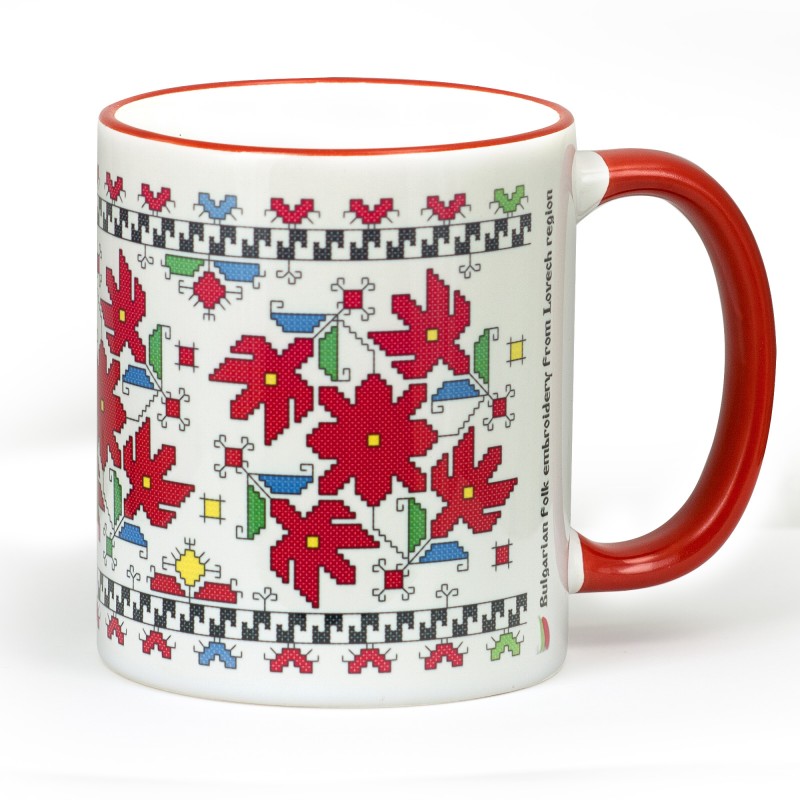
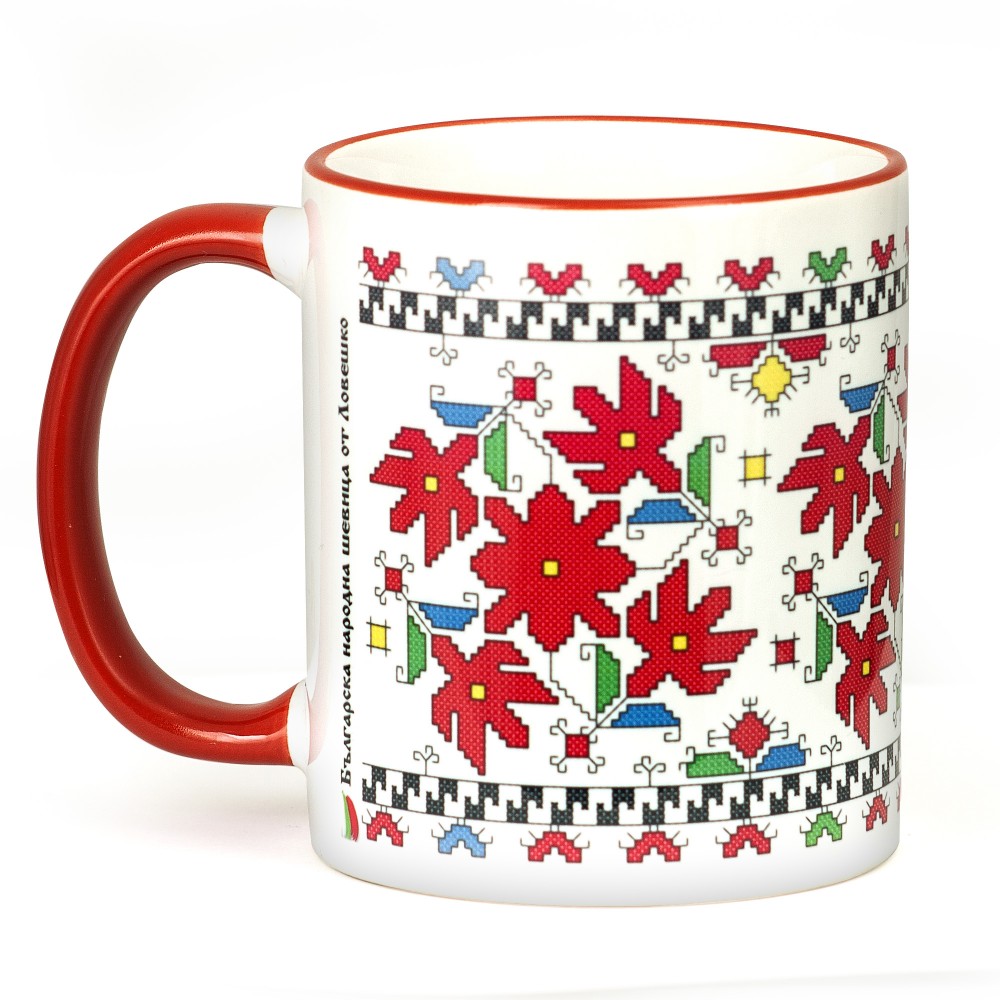
Size: h=10cm, ф=8.5cm
Capacity: 330ml
Material: Ceramics
A high quality stamp made with health-friendly inks, resistant to dishwasher detergents.
The model is taken from the Album “Bulgarian Folk Embroideries” compiled by Rositsa Chukanova, published by the “Bulgarian artist” publishing house in Sofia in 1957 and its photo-type copy, made by Georgi V. Markov in Plovdiv in 2017.
For the first time this embroidery is mentioned in the book of Ivan Koev “Bulgarian embroidery ornaments” as an example of the transformation of the oldest known symbol of human history- the swastika. In the different cultures across the world this symbol has identical meaning – it symbolizes the sun and the holly fire.
In Bulgaria the swastika cross is embroidered mainly on women’s shirt sleeves and frontal parts in the Sofia, Tran, Stankedimitrov, Lovetch and Karnobat regions.
However, this symbol is traditional for the old Bulgarians’ lifestyle and can be seen in different objects from the past – on woodcarvings, houses, Easter ritual breads, women’s distaffs, Easter eggs and tombstones.
Christianity doesn’t reject the swastika as a pagan symbol, on the contrary, it interprets it in a new way and that is why many clerical items are also ornamented with it.
The Bulgarian embroidery ornaments have preserved the symbolism of the swastika from the times of the Thracians and Slavs through Ancient Greek, Roman and Christian epochs till present days. Since ancient times the meaning of this symbol has been identical. It represents wishes for success and prosperity, a token of good will and predictions of well-being, wishes for happiness and prevention of unhappiness.
If you want to learn more about Bulgarian crafts, please visit www.tour4fun.info .
27 other products in the same category:
-

Mug with embroidery from the Bourgas region
Luxury packaging & free delivery to any hotel in Sofia.
10,00€
Add to cart -

Mug with embroidery from the Sofia region
Luxury packaging & free delivery to any hotel in Sofia.
10,00€
Add to cart -

Mug with embroidery from the Dupnitsa region
Luxury packaging & free delivery to any hotel in Sofia.
10,00€
Add to cart -

Mug with "Svilenitsa" embroidery from the...
Luxury packaging & free delivery to any hotel in Sofia.
10,00€
Add to cart -

Mug with "Svilenitsa" embroidery from the...
Luxury packaging & free delivery to any hotel in Sofia.
10,00€
Add to cart -

A mug with an embroidery from the Dobrich...
Luxury packaging & free delivery to any hotel in Sofia.
10,00€
Add to cart -

Mug with "Shevitsa" embroidery from the...
Luxury packaging & free delivery to any hotel in Sofia.
10,00€
Add to cart -

A mug with an embroidery from the Elhovo region
Luxury packaging & free delivery to any hotel in Sofia.
10,00€
Add to cart -

Mug with embroidery from the Graovo region
Luxury packaging & free delivery to any hotel in Sofia.
10,00€
Add to cart -

Mug with embroidery from the Samokov region
Luxury packaging & free delivery to any hotel in Sofia.
10,00€
Add to cart -

A mug with embroidery from the Sliven region
Luxury packaging & free delivery to any hotel in Sofia.
10,00€
Add to cart -

A mug with embroidery from the Varna region
Luxury packaging & free delivery to any hotel in Sofia.
10,00€
Add to cart -

Mug with "Shevitsa" embroidery from the...
Luxury packaging & free delivery to any hotel in Sofia.
10,00€
Add to cart -

A mug with embroidery from the Pleven region
Luxury packaging & free delivery to any hotel in Sofia.
10,00€
Add to cart -

A mug with embroidery from the Passarel region
Luxury packaging & free delivery to any hotel in Sofia.
10,00€
Add to cart -

A mug with embroidery from the Pleven region
Luxury packaging & free delivery to any hotel in Sofia.
10,00€
Add to cart -

A mug with embroidery from the Lovech region
Luxury packaging & free delivery to any hotel in Sofia.
10,00€
Add to cart -

Mug with embroidery from the Elin Pelin region
Luxury packaging & free delivery to any hotel in Sofia.
10,00€
Add to cart -

Mug with "Shevitsa" embroidery from the...
Luxury packaging & free delivery to any hotel in Sofia.
10,00€
Add to cart -

A mug with embroidery from the Vidin region
Luxury packaging & free delivery to any hotel in Sofia.
10,00€
Add to cart -

A mug with embroidery from the Strandzha region
Luxury packaging & free delivery to any hotel in Sofia.
10,00€
Add to cart -

A mug with embroidery from the...
Luxury packaging & free delivery to any hotel in Sofia.
10,00€
Add to cart -

A mug with embroidery from the...
Luxury packaging & free delivery to any hotel in Sofia.
10,00€
Add to cart -

A mug with embroidery from Vratsa/northwest...
Luxury packaging & free delivery to any hotel in Sofia.
10,00€
Add to cart -

A mug with embroidery from the Prespa region
Luxury packaging & free delivery to any hotel in Sofia.
10,00€
Add to cart -

A mug - Tree of life with embroidery
Luxury packaging & free delivery to any hotel in Sofia.
10,00€
Add to cart -

A mug with embroidery from the...
Luxury packaging & free delivery to any hotel in Sofia.
10,00€
Add to cart